Treatment Guide
The 12-Question Thermage FLX Vetting Checklist
Print this before you book. A brand-neutral framework from a Taipei reader who learned the hard way.
Hi, Chen Xiao-Yu here. After two trips to Gangnam and one awkward refund conversation, I built this 12-question checklist so other Taiwanese, Hong Kong, and Singaporean readers can vet a Thermage FLX clinic in twenty minutes. This page lists ZERO clinic names on purpose. The goal is to teach you the screen. If you ask all twelve questions in writing and the clinic answers clearly, you have filtered out roughly 60% of the market. Treat this as the pre-booking equivalent of a building inspection report.
Ranking lists mostly reflect ad spend and SEO budget. They do not tell you whether the device under your face is a genuine Thermage FLX or an off-brand RF lookalike. A vetting checklist forces the clinic to disclose, in writing, the specific data points that protect you. The Korean Ministry of Food and Drug Safety (MFDS) maintains a public medical device registration database. Solta Medical maintains a global certified provider directory at https://www.solta.com. The Korea Health Industry Development Institute (KHIDI) maintains foreign-patient licensing data. Three independent registries means three independent verifications. If a clinic refuses to disclose information that lives in a public database, that refusal is the signal.
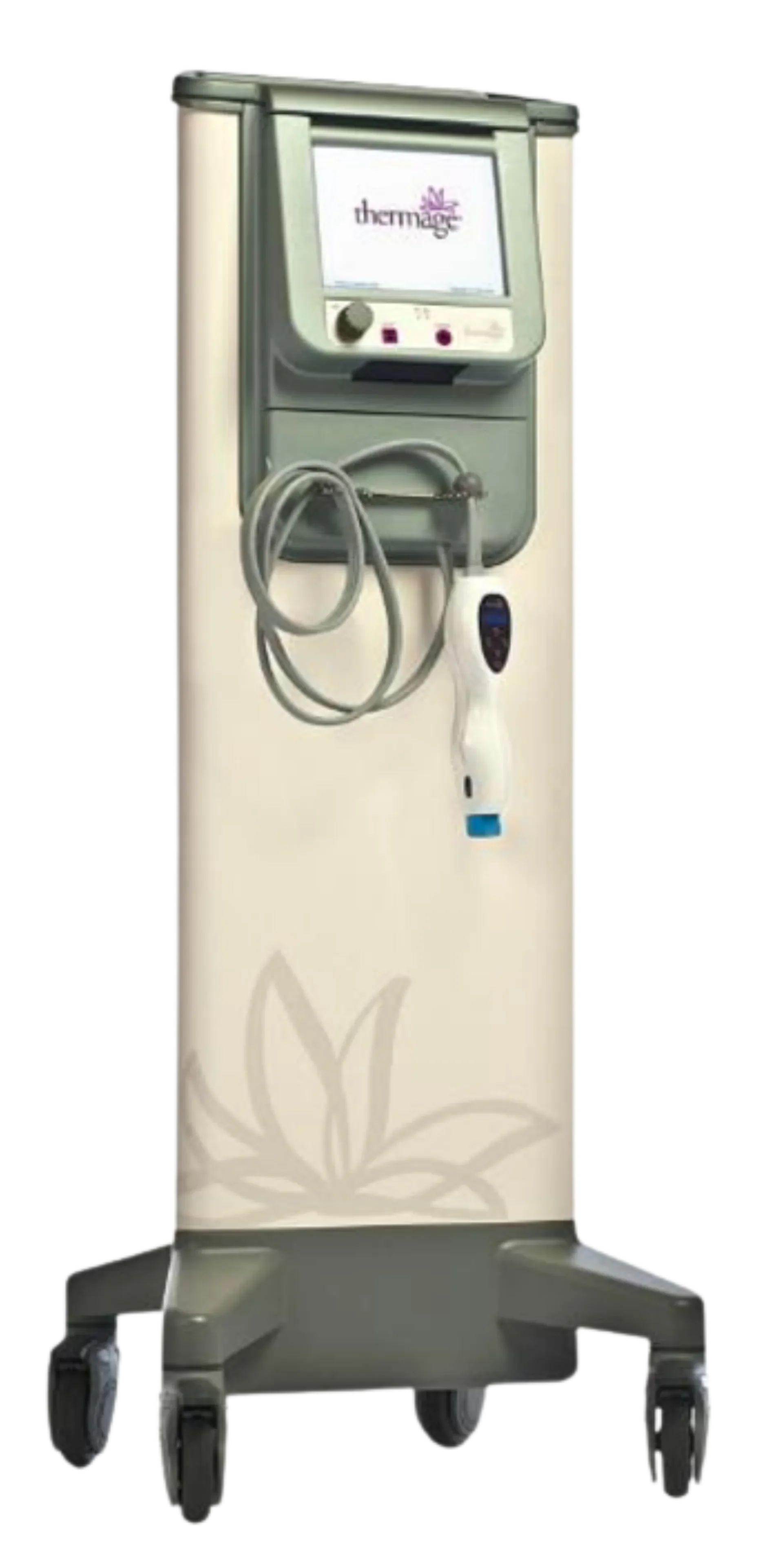
Thermage FLX is the fourth-generation Solta Medical RF device, released globally in 2017 and approved in Korea by MFDS shortly after. Older Thermage CPT machines are still in circulation. CPT is not bad, but it is not FLX. The price you pay should match the device on the cart. Ask: 'May I see the device label and the MFDS device registration number before treatment?' A confident clinic will photograph the rear label of the machine, which lists the model number, serial number, and Korean importer. If the answer is 'we will show you on the day,' you walk.
Thermage FLX uses single-use cartridges. The most common is the 4.0 cm² Total Tip 4.0 (sometimes called the Face Tip), with Eye Tip and Body Tip variants. Each cartridge has a fixed pulse count, typically 900 pulses for the Total Tip 4.0. Ask the coordinator to confirm the cartridge model and pulse count IN WRITING before deposit. On the day, ask them to open the cartridge in front of you. The foil pouch should be intact, the QR code unscratched, and the pulse counter should read at or near the full capacity. If the cartridge is pre-loaded when you sit down, ask politely for them to swap it. This is your right.
Korean law allows licensed physicians to delegate certain device operations to trained nurses under supervision, but the rules differ by procedure. For Thermage FLX specifically, market practice in Gangnam ranges from doctor-only delivery to nurse-delivered with doctor supervision. Neither is automatically wrong, but the price you pay should reflect the actual operator. Ask: 'Will a licensed physician personally perform the Thermage FLX shots, or will a nurse deliver them?' Then ask: 'What is the physician's Korean medical license number?' You can cross-check that number on the Korean Medical Association registry.
Pulse count is the biggest hidden variable in Thermage FLX pricing. A genuine full-face session typically uses 600 to 900 pulses. Some clinics quote a low headline price but deliver 300 to 400 pulses, which is half a treatment. Ask for the planned pulse count BEFORE treatment, and ask for the actual delivered count printed on the receipt AFTER. The cartridge has a built-in counter the operator can display on screen. Reluctance to commit or print the readout is a red flag.
Thermage FLX is uncomfortable but not unbearable. Most Gangnam clinics offer topical anesthesia cream as standard, oral analgesics on request, and a small minority offer nitrous oxide laughing gas for an extra fee. None of these change the clinical outcome, but they change the price. Ask whether topical cream, oral painkillers, and gas are included in the quoted price, charged separately, or sold as a package. A clear answer is fine in either direction. An evasive answer is the problem.
Korean law requires clinics treating overseas patients to register with KHIDI, the Korea Health Industry Development Institute. KHIDI publishes the licensed clinic list at https://www.khidi.or.kr. If a clinic markets to international visitors but does not appear on the KHIDI list, you are at higher risk if anything goes wrong, because the dispute resolution channel is informal. Ask for the KHIDI registration number. It will look like A-2026-MM-DD-NNNNN.
If you do not speak Korean, ask exactly which staff member will translate during consultation, treatment, and aftercare. Will it be a full-time in-house coordinator, a freelance interpreter, or a Google Translate session on the doctor's iPad? All three exist in Gangnam. None is automatically disqualifying, but you should know which you are buying. For Mandarin readers, ask whether the coordinator speaks Traditional or Simplified, and whether they can WeChat or LINE you for aftercare follow-up after you fly home.
Thermage FLX has minimal downtime, but the first 72 hours matter. Ask what the clinic provides: cooling mask, anti-inflammatory cream, written aftercare sheet in your language, follow-up call or message at 24/48/72 hours. A clinic that hands you a Korean-only sheet and waves you out the door is not serving international patients well, even if the treatment itself was fine.
Thermage FLX results emerge gradually over 2 to 6 months. Some patients see noticeable lift at week 4, others at month 3. Ask the clinic, in writing, what their policy is if you feel under-treated at the 90-day mark. Some clinics offer a complimentary 'top-up' session of 100 to 200 pulses. Others charge full price. Both are legitimate. Knowing in advance prevents the awkward conversation later.
An itemized receipt is your single best protection. It should list: clinic name and business registration number, treatment date, device model and serial, cartridge model and pulse count, operating physician name and license number, price breakdown by line item, and VAT. Without this, you cannot file a complaint with MFDS, KHIDI, or your home country's consumer protection authority. Ask for the receipt template BEFORE you pay deposit.
Most Gangnam clinics accept Korean credit cards, international Visa/Mastercard, and bank transfer. A growing number accept WeChat Pay and Alipay through cross-border gateways. Cash discounts of 5 to 10% exist but reduce your dispute leverage to zero. Ask: 'If I pay by international credit card, what is the refund window if I cancel before treatment?' The answer should be clear and in writing.
This is the question almost no one asks until they need it. Thermage FLX complications are rare but include prolonged erythema, blistering, fat atrophy, and nerve irritation. Ask for the emergency contact card: clinic 24-hour line, lead physician's mobile or LINE, English/Mandarin/Japanese after-hours channel, and the partner hospital they would refer you to in Seoul if needed. If you fly home before symptoms resolve, you need a channel that works across time zones.
1) Refusal to show the device label or cartridge pouch. 2) 'All-inclusive' pricing without a written pulse count. 3) No KHIDI registration number. 4) Coordinator who insists you pay in cash to 'avoid card fees.' 5) Pressure to upgrade to a higher-tier package during consultation, especially using countdown timers or 'today only' framing. 6) Reviews that all sound the same on Naver, Instagram, and RED, with identical phrasing translated awkwardly between languages.
Copy the 12 questions into one message and send to 3 to 5 clinics via their official channel before you fly. Compare answers side by side in a spreadsheet. The clinic that answers all 12 clearly, in your language, with documentation attached, is the clinic that respects you as an international patient. Price should be the LAST filter, not the first.
“A clinic that answers twelve questions in writing has already done the work most patients never see. That is the work you are paying for.”
Frequently asked questions
Is the Thermage FLX device legally registered in Korea?
Yes. Thermage FLX is registered with the Korean Ministry of Food and Drug Safety (MFDS) as a medical device. You can request the device registration number from the clinic and cross-check it on the MFDS public database.
How do I verify a clinic is licensed to treat foreign patients?
Ask for the clinic's KHIDI (Korea Health Industry Development Institute) registration number. KHIDI publishes the licensed clinic list at https://www.khidi.or.kr and the number format is A-YYYY-MM-DD-NNNNN.
What is the difference between Thermage FLX and Thermage CPT?
FLX is the fourth-generation Solta Medical device with AccuREP technology and a larger 4.0 cm² Total Tip. CPT is the third-generation predecessor. Both are FDA-cleared, but FLX is faster and generally more comfortable. Pay FLX price only if you are getting FLX device.
Should I worry if a nurse performs the treatment instead of a doctor?
Not automatically. Korean law permits licensed physicians to delegate certain operations to trained nurses under supervision. The issue is transparency. Ask in advance, confirm the operator, and adjust your expected price accordingly.
Why is pulse count so important?
Pulse count is the single biggest hidden price variable. A genuine full-face Thermage FLX session uses 600 to 900 pulses. Some clinics deliver 300 to 400 pulses at a discount price. The cartridge has a built-in counter, so ask for the post-treatment readout to be printed on your receipt.
What languages should I expect coordinators to speak?
Gangnam clinics that serve international patients typically offer Mandarin, English, and Japanese. Hong Kong-Cantonese is less common but growing. Confirm the specific language and the specific staff member before you commit.
Is it safe to pay in cash for a discount?
Legally safe, but practically unwise. Paying by international credit card preserves your chargeback rights if the clinic delivers something materially different from what was promised. A 5 to 10% cash discount is rarely worth losing that protection.
What if I notice a complication after I fly home?
Contact the clinic's after-hours channel immediately, document with timestamped photos, and consult a dermatologist in your home country. Most international-friendly Gangnam clinics maintain LINE or WeChat channels specifically for post-trip follow-up. Confirm this channel exists BEFORE you fly.